![Resitacox.com [new]](http://images.squarespace-cdn.com/content/v1/61fc12b4314bee0257852578/3fe60e17-ad5e-4149-ade4-a00bcc335385/Resita+Name+Logo+2021.png?format=1500w)
The Industry Still Doesn't Reflect My Surroundings
Reflections on the Documentary Film Industry by an Emmy-Award winning, radical, queer Black feministBy Resita Heavenly Cox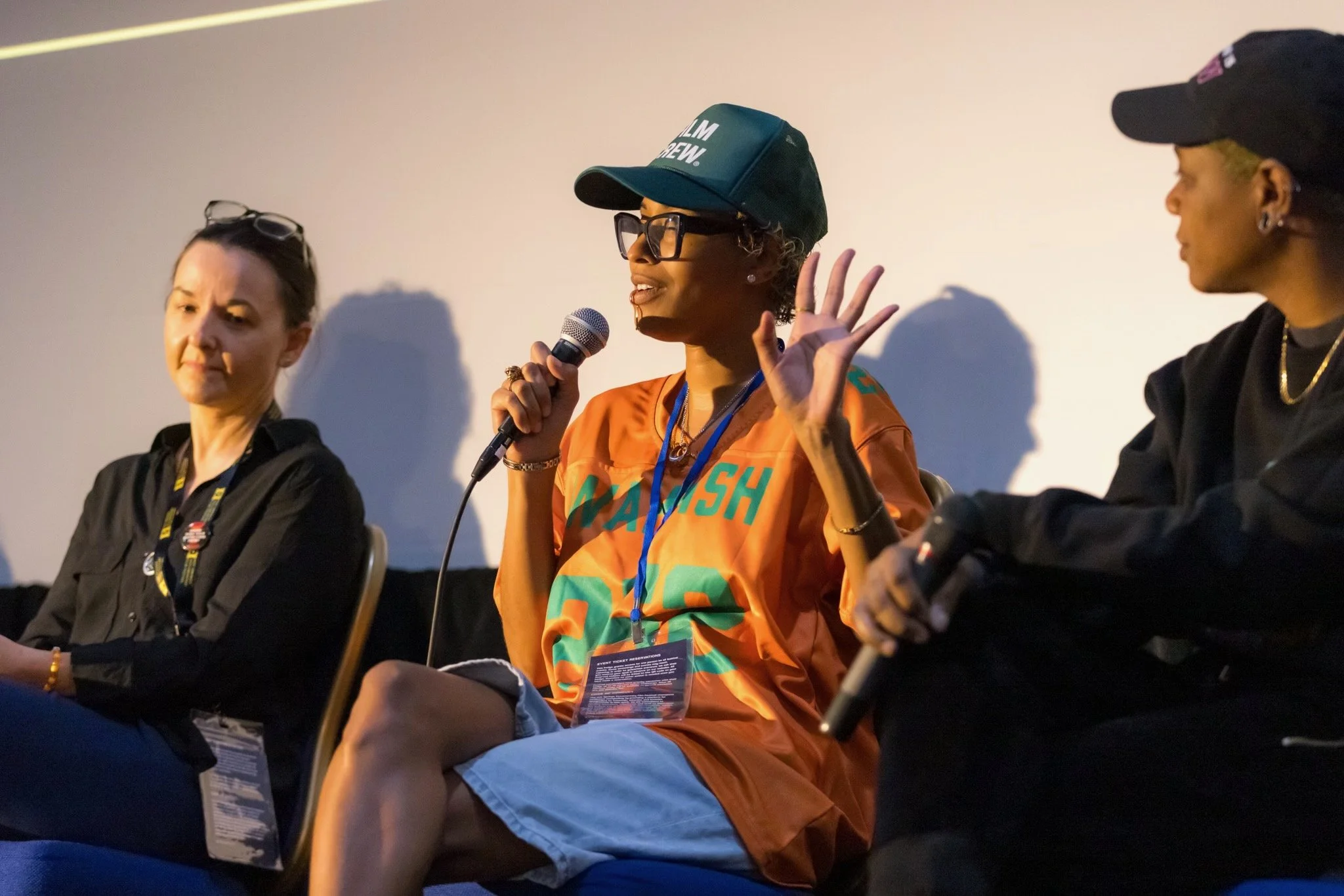
Resita Cox speaking on the Where Are The Southern Accents? panel during the 2025 Filmmaker Forum at Hot Springs Film Festival.
“Quite frankly, I’ve been moving so fast that I barely stopped to notice I’ve kind of done the impossible. I’d written my own ticket into the film industry…”
My office is a quaint, colorful, little space.
A black canvas with BLACK OWNED THINGS[original artwork by Kyel Joi Brooks, 2021] written in white paint hangs on the wall, greeting you upon entry. A medium-sized teddy-bear wearing a black tux sits atop a trophy with cursive words etched into its wooden base: “Best Documentary Short, Freedom Hill, Middlebury New Filmmakers Festival 2022.”
Beside it, another film award, this one proudly proclaiming, “Best NC Filmmaker, Equity Films, 2023.”
Tucked in between each award are framed photos of various film homies: Ashley O’Shay (Unapologetic, PBS) and I at Doc NYC in 2021; Jon Ayon (No Soy Óscar, 2022) and I during my 2023 sabbatical in the Bay.
Above my desk, positioned to be visible in the background, is the movie poster for my debut film, Freedom Hill, which tells the story of environmental racism through the first Black town in America, Princeville, NC. This film offering grew into my annual Freedom Hill Youth Media Camp, which has given more than $50,000 in funding to Black youth filmmakers in the rural South to date, a core part of the film’s impact campaign in 2022.
In 2023, Freedom Hill was sold to PBS following its successful run in over 20 international film festivals, where it earned numerous awards. Later that same year, I was awarded a Chicago Emmy for directing an episode of WTTW’s Life After Prison.
My office is full of artifacts. It’s a museum of my life, a frozen time capsule of my biggest moments—a living, breathing testament to my past decade of work as a filmmaker and storyteller.
If you look closely, each framed newspaper article hanging beside Freedom’s movie poster, and every piece of art in the space will unfold the story of my career, my pride and joy, my life’s work—dating back to high school, when I was named the top student journalist in North Carolina.
I often plant myself at my desk and stare at the awards around me. Quite frankly, I’ve been moving so fast that I barely stopped to notice I’ve kind of done the impossible. I’d written my own ticket into the film industry; went to market with a Black ass movie, uncensored; and landed first-look deals with the likes of Hulu, Kartemquin, with offers from even larger conglomerates, eventually landing national distribution on PBS. Freedom Hill is also being archived at Duke University.
Even in those early days, many considered me successful, both in perception and on paper. My debut film project began in 2019, just one year after leaving the TV news industry as a television reporter and producer. Production concluding in 2021. It premiered in 2022 to a sold-out audience at the Full Frame Documentary Film Festival in Durham, NC, where it was one of only 15 short documentaries featured that season.
Shortly after transitioning into film from television news in 2018 as a freelance impact and field producer, my life quickly turned into back to back flights, film festivals, artist fellowships, film sets and red carpet movie premieres.
I landed my first major industry film fellowship just one year in the game as a 2021 North Star Fellow with the prestigious Camden International Film Festival through Points North Institute. Only 27 and looking every bit of it, the other fellows didn’t shy from asking immediately, “how old are you, Resita?”
When I responded honestly, the room grew quiet. A follow up question. “How many times did you apply to this?”
Once, I said. Silence. Finally, I found a response in their game of questions: “Well, how old is y'all? And how many times did you apply?” I asked the Native Indigenous woman who presented the original questions.
Slowly, my cohort revealed their ages and the stark gaps taught me my first lesson in film.
While I was the only filmmaker under 35 in my entire cohort, I was also the only Black woman as well as the only person who applied, and accepted, on their first try with their first movie.
This dialogue taught me what I had failed to notice in my aggressive pursuit of success: I had somehow become the exception to a dark industry rule created to keep radical, queer, Black women out of spaces that serve the status quo.
My god, a nigga done infiltrated.
Despite that realization at the time, I was still driven by a need to prove myself and break down further barriers. Therefore, I dedicated myself completely to the task at hand.
Immediately after Freedom Hill’s community and festival screening circuits were winding down, I flew to New Orleans in 2023 and debuted my next project to a room full of industry giants, such as Sundance, PBS, ITVS, and honestly, anyone in between, as a participant in their highly-attended Documentary South Pitch Competition.
I call it the pitch heard around the world.
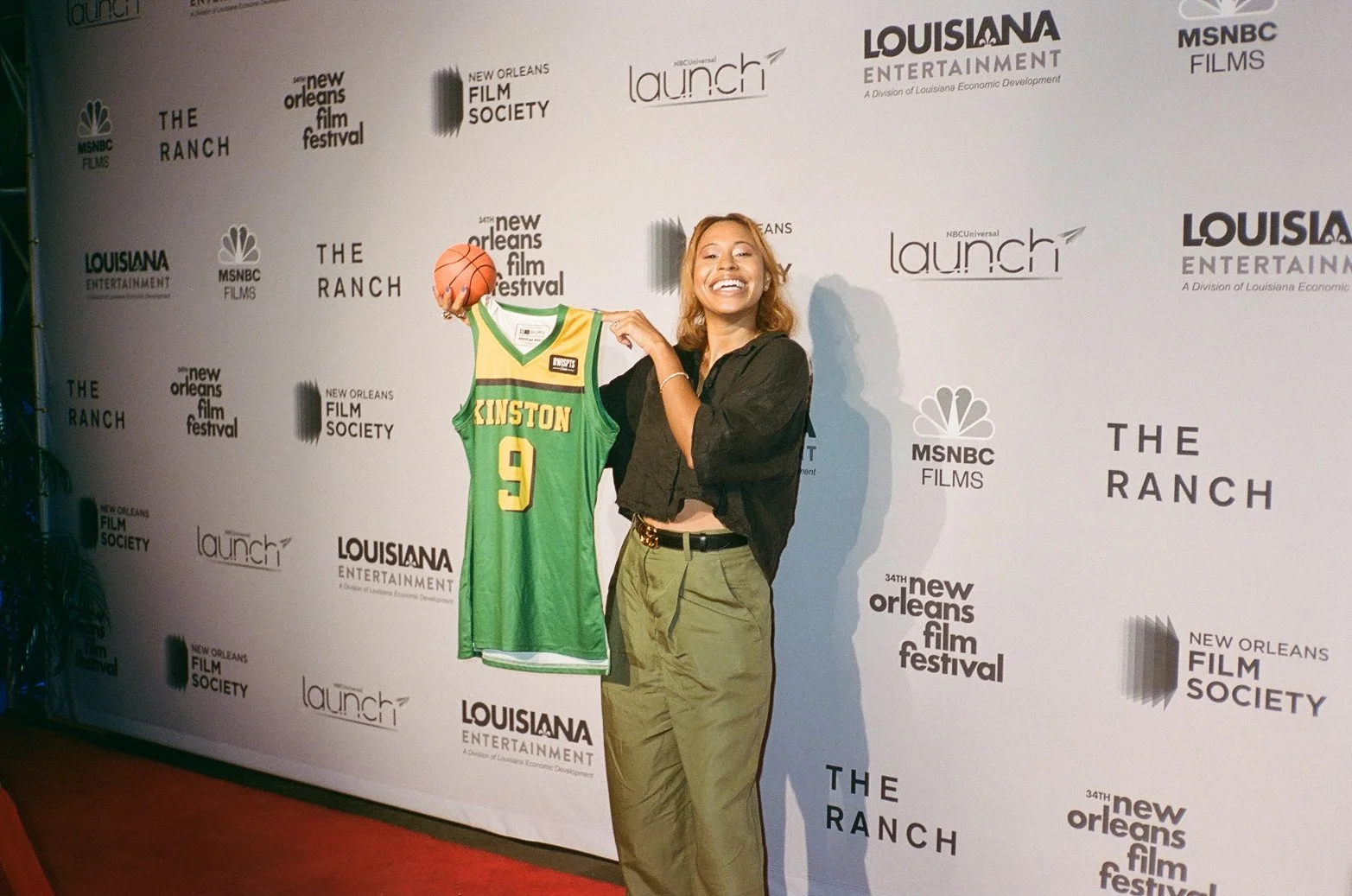
My debut feature, Basketball Heaven, secured a $10,000 seed grant after I won the competition. This film is a poetic love letter to my hometown, recognized as the single greatest per capita producer of NBA talent globally.
The project quickly garnered support from major organizations, including Sundance and ITVS, through their competitive Open Call initiative. Now, as we move into post-production, the wealth of knowledge I’ve gained has brought me back to Duke University. This time, however, I’m an instructor for "Doc Film for Social Impact," a course I personally conceptualized and created.
My class at Duke is a continuing education class, meaning my students are working artists, prestigious professors, novelists and creators in their own right. It is made up of women of color—two Native women, two Black women, one Asian woman, and one Indian woman. My other offering—the Impact and Indie Film School—only in its prototype stage, has only attracted women of color.
If every offering, every learning space I’ve ever created, down to my youth film camp, is majority Black women and women of color, then why the industry so white?
The math ain’t mathing.
Well, that math won’t math until you factor in the barriers to entry our industry has fed off of since its inception.
While women of color garner the highest reviews among critics and audiences, they still account for less than 20% of the industry and are historically given the lowest budgets. Even those who broke in are still begging for crumbs.
Julie Dash, one of my film elders and a legend in the game, was reported participating in the same industry pitch market that I participated in just a few years ago—Julie Dash begging for coins?! What planet are we on, yall?
The learning spaces I’ve curated since gaining the knowledge I have around navigating this grueling industry have taught me my second major lesson in film—Black women, and women of color in general, are knocking, and have been for decades, but the door has yet to budge, even a little.
In fact, that bitch is padlocked three times over.
So, as an abolitionist and solution-oriented Aries Sun, I sat with this revelation and then I created a strategy to combat it, starting with my impact class offering at Duke, and now with the Impact and Indie Film School, open to any and all, offered both in person and online.
Both of these offerings were created to decolonize our industry, and pass over resources that have been locked behind the aforementioned door for decades. Essentially, they let a nigga in and now I’m holding this door open to bring more.
Check mate.
So, what is next?
Well, I’ll tell you. The key to accessing my treasure trove of game? A core requirement to participate in any of my offerings is to lead with impact. This journey begins with their first assignment: surveying their community to identify film elders and form their wise council board. This assignment is essential for guiding participants toward their final film philosophy and creative values statement, as well as their movie's impact strategy.
Leading with impact means developing a contribution to the community that goes beyond the film itself—something that will endure long after the story is told. This doesn't have to be a large-scale initiative, such as my annual camp that gives away money like it grows on trees, but it must be a tangible offering in addition to your movie.
I firmly believe that by providing women of color with resources and the knowledge to direct a film with impact from the outset, we can fundamentally change the key contributors of our industry. This change will happen, one by one, through each movie and each impact campaign.
Game on.
—resita heavenly cox